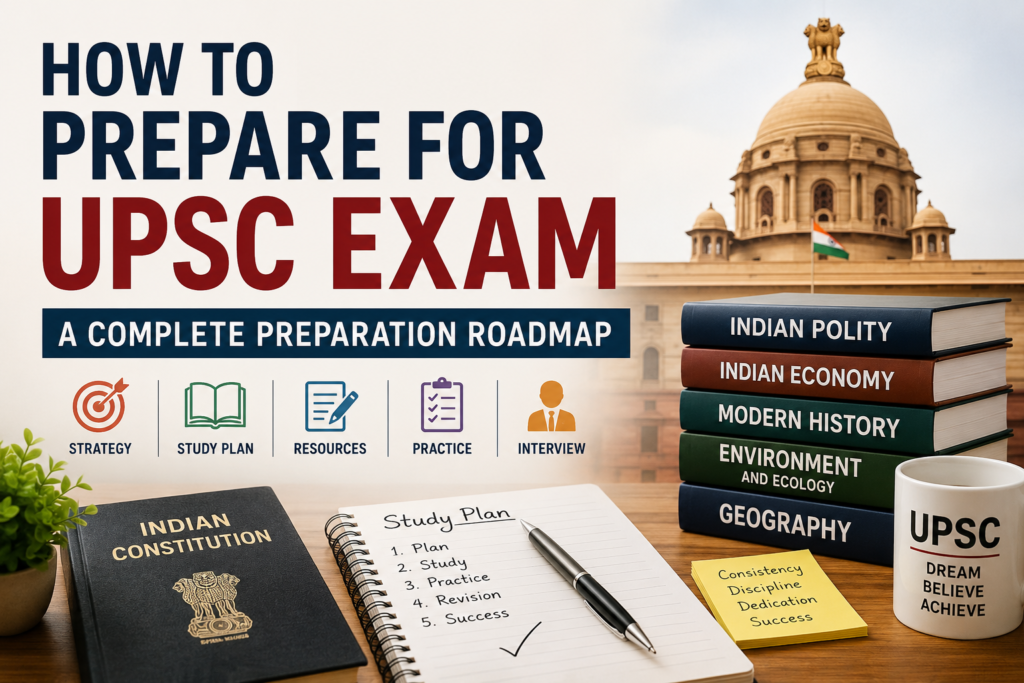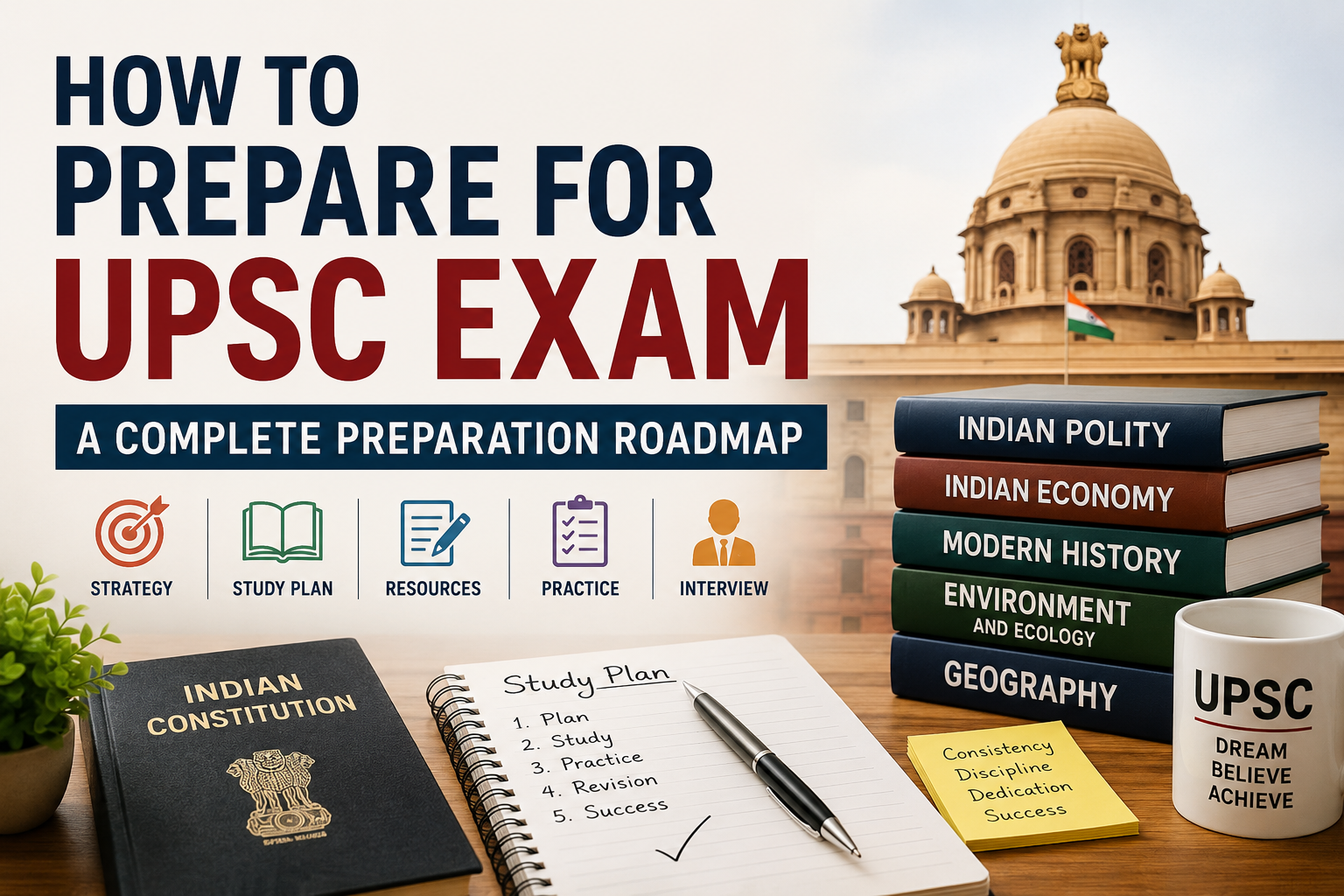
How to Prepare for UPSC Exam: Learn how to prepare for the UPSC Exam with this complete preparation roadmap. Discover the best study plan, books, answer-writing tips, current affairs strategy, and expert guidance for Prelims, Mains, and Interview.
How to Prepare for UPSC Exam : A Complete Roadmap for Success
The UPSC Civil Services Examination is often described as one of the toughest competitive exams in India. Every year, lakhs of aspirants dream of becoming IAS, IPS, IFS, and other civil servants, but only a small percentage successfully clear all stages of the examination.
While the journey may seem overwhelming, the truth is that UPSC is not just about intelligence—it’s about consistency, planning, discipline, and smart preparation. With the right strategy and resources, any dedicated aspirant can improve their chances of success.
In this article, we’ll explore a step-by-step roadmap to help you prepare effectively for the UPSC Civil Services Examination.
Understanding the UPSC Exam Pattern
Before starting your preparation, it is important to understand the structure of the examination.
Stage 1: Preliminary Examination (Prelims)
The Preliminary Examination consists of two objective-type papers:
General Studies Paper I
- History
- Geography
- Indian Polity
- Economy
- Environment and Ecology
- Science and Technology
- Current Affairs
CSAT (General Studies Paper II)
- Comprehension
- Logical Reasoning
- Analytical Ability
- Decision Making
- Quantitative Aptitude
The Prelims acts as a screening test, and only qualified candidates move to the next stage.
Stage 2: Main Examination (Mains)
The Mains examination is descriptive in nature and includes:
- Essay Paper
- General Studies Papers I, II, III, and IV
- Two Optional Subject Papers
- English Language Paper
- Regional Language Paper
The marks obtained in Mains play a major role in determining your final rank.
Stage 3: Personality Test (Interview)
The final stage assesses your personality, communication skills, decision-making ability, awareness, and suitability for a career in public service.
Build a Realistic Study Plan
Many aspirants begin their preparation with enthusiasm but lose momentum due to poor planning. A realistic study plan can help maintain consistency throughout the journey.
Set Clear Goals
Break the vast syllabus into smaller sections and create monthly, weekly, and daily targets.
For example:
- Complete one NCERT subject every two weeks.
- Revise current affairs every Sunday.
- Write three Mains answers daily.
Balance Prelims and Mains Preparation
Avoid preparing for Prelims and Mains separately. Most topics overlap, so build a foundation that serves both stages simultaneously.
Reserve Time for Revision
Revision is often the difference between success and failure. Allocate at least 20-30% of your study time for revision.
Start with NCERT Books
NCERT textbooks are considered the foundation of UPSC preparation.
Begin with:
- History NCERTs (Class 6–12)
- Geography NCERTs (Class 6–12)
- Political Science NCERTs
- Economics NCERTs
These books help build conceptual clarity and make advanced reference books easier to understand.
Refer to Standard UPSC Books
After completing NCERTs, move to standard reference books.
History
- India’s Struggle for Independence – Bipan Chandra
- A Brief History of Modern India – Spectrum
Polity
- Indian Polity – M. Laxmikanth
Geography
- Certificate Physical and Human Geography – G.C. Leong
Economy
- Indian Economy – Ramesh Singh
Environment
- Environment and Ecology – Shankar IAS
These books are highly recommended by successful candidates and UPSC mentors.
Master Current Affairs
Current affairs form the backbone of UPSC preparation.
Read Newspapers Daily
Focus on:
- The Hindu
- Indian Express
While reading, pay attention to:
- Government policies
- International relations
- Economy
- Environment
- Social issues
Follow Reliable Sources
Useful resources include:
- PIB (Press Information Bureau)
- Yojana Magazine
- Kurukshetra Magazine
- PRS Legislative Research
The goal is not to read everything but to understand issues from multiple perspectives.
Make Smart Notes
Good notes can save hundreds of hours during revision.
Keep Notes Short
Instead of copying entire paragraphs, summarize information in:
- Bullet points
- Flowcharts
- Mind maps
Connect Current Affairs with Static Subjects
For example, if a climate summit is in the news, link it to Environment and Geography topics in your notes.
This integrated approach helps during Mains answer writing.
Develop Strong Answer Writing Skills
Many aspirants know the content but struggle to present it effectively.
Practice Daily
Start writing answers as early as possible.
Focus on:
- Structure
- Clarity
- Time management
Follow the UPSC Answer Format
A good answer generally includes:
Introduction
- Define the topic or provide context.
Body
- Explain key points with examples, facts, and analysis.
Conclusion
- End with a balanced and optimistic viewpoint.
Use Visual Elements
Where appropriate, include:
- Maps
- Diagrams
- Flowcharts
- Data points
These improve presentation and fetch extra marks.
Take Mock Tests Regularly
Mock tests help you evaluate your preparation and identify weak areas.
For Prelims
- Practice MCQs regularly.
- Improve elimination techniques.
- Learn to manage negative marking.
For Mains
- Join a test series.
- Write answers within the prescribed time.
- Analyze feedback carefully.
Remember, every mock test is an opportunity to improve before the actual exam.
Prepare for the UPSC Interview
The Personality Test is not a knowledge quiz. The board evaluates your personality and suitability for public service.
Stay Updated
Be aware of:
- Current affairs
- Issues related to your home state
- Graduation subject
- Optional subject
Improve Communication Skills
Practice speaking clearly and confidently.
Mock interviews can help reduce nervousness and improve body language.
Be Honest
If you don’t know an answer, admit it politely. Confidence combined with honesty creates a positive impression.
Common Mistakes to Avoid
Many aspirants make similar mistakes during preparation:
- Collecting too many study materials
- Ignoring revision
- Neglecting answer writing practice
- Overdependence on coaching notes
- Comparing preparation with others
- Focusing only on current affairs
Avoiding these mistakes can significantly improve your preparation quality.
Final Thoughts
UPSC preparation is a marathon, not a sprint. There will be moments of self-doubt, setbacks, and challenges along the way. However, consistent effort, disciplined study habits, regular revision, and a positive mindset can make a significant difference.
Remember, every successful civil servant once started as a beginner with the same syllabus and the same 24 hours in a day. Focus on continuous improvement rather than perfection.
Stay committed to your goals, trust the process, and keep moving forward. With the right strategy and determination, your dream of serving the nation through the Civil Services can become a reality.