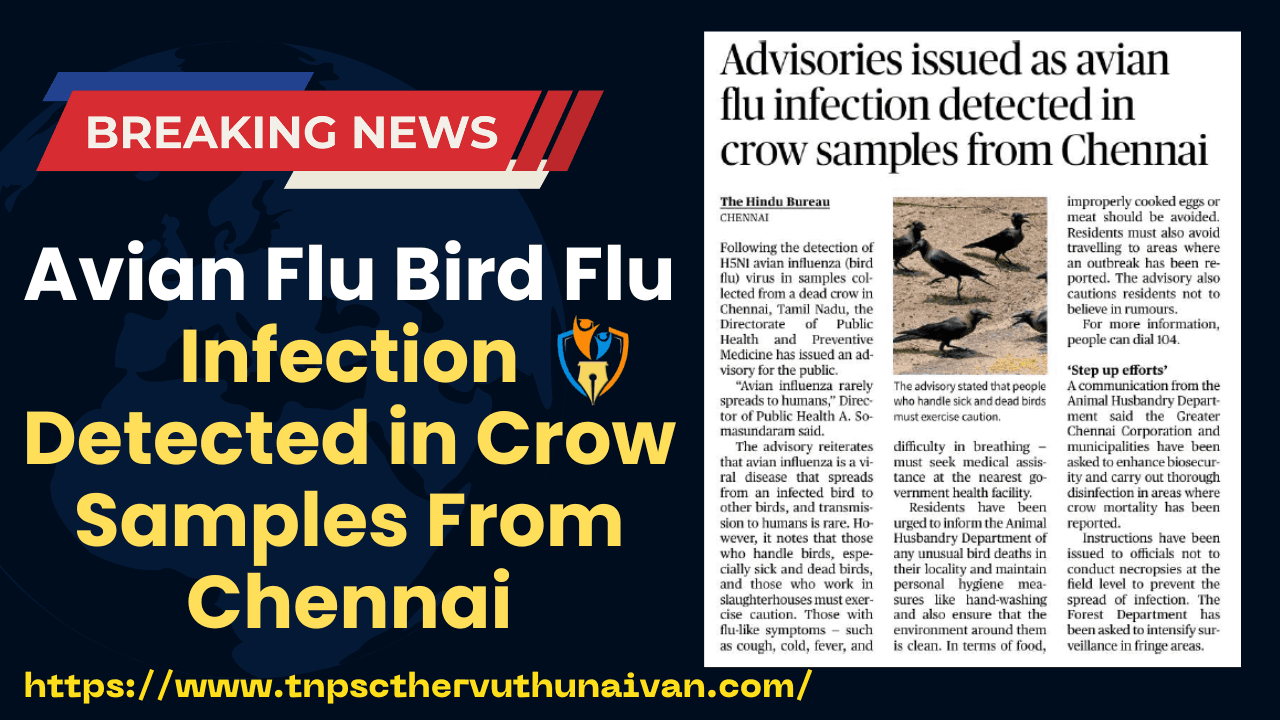
Avian Flu Bird Flu infection has been detected in crow samples from Chennai, raising health surveillance and poultry safety concerns. Authorities are monitoring the situation to prevent the spread of the virus.
Avian Flu Bird Flu
1. Introduction
Avian Influenza (Bird Flu) refers to infection caused by Influenza A viruses that primarily affect birds but can occasionally infect mammals, including humans. Among them, H5N1 is a Highly Pathogenic Avian Influenza (HPAI) strain known for causing severe disease and high mortality in poultry and sporadic but serious infections in humans.
2. Scientific Basis of the Disease
2.1 Nature of the Virus
- Caused by Influenza A virus belonging to the Orthomyxoviridae family.
- It is a zoonotic disease, meaning it can cross from animals to humans.
- Wild aquatic birds act as natural reservoirs of the virus.
2.2 Viral Classification
- Influenza A viruses are classified based on surface proteins:
- Hemagglutinin (H) – 18 subtypes
- Neuraminidase (N) – 11 subtypes
- H5N1 denotes a virus with H5 hemagglutinin and N1 neuraminidase proteins.
- These proteins determine virulence, host specificity, and immune response.
2.3 Pathogenic Types
- Low Pathogenic Avian Influenza (LPAI) – Mild disease
- Highly Pathogenic Avian Influenza (HPAI) – Severe, systemic infection
- H5N1 belongs to HPAI, causing high mortality in poultry.
3. Origin and Global Spread
- First identified in China in 1996.
- Rapid mutation led to a highly pathogenic strain.
- Since 2020, spread recorded across Europe, Africa, Asia, North America, South America, and even Antarctica via migratory birds.
- In India, early major outbreaks were reported in Maharashtra and Gujarat.
4. Transmission Mechanism
4.1 Among Birds
- Spread through saliva, nasal secretions, and faeces.
- Contamination of water bodies, feed, cages, and equipment.
- Migratory flyways enable long-distance transmission.
4.2 To Humans
- Direct contact with:
- Infected birds
- Carcasses
- Contaminated environments
- High risk in live bird markets and farms with poor biosecurity.
4.3 Human-to-Human Transmission
- No sustained transmission observed.
- Sporadic cases occur but pandemic risk remains low at present.
5. Clinical Features and Pathology
5.1 In Birds
- Sudden death
- Respiratory distress
- Neurological symptoms
- Diarrhoea
- Drop in egg production
- Multi-organ failure
5.2 In Humans
- High fever
- Cough and sore throat
- Muscle pain
- Severe pneumonia
- May progress to Acute Respiratory Distress Syndrome (ARDS)
- Human case fatality rate reported to be around 50–60% among confirmed cases.
6. Prevention and Control Measures
6.1 Biosecurity
- Restrict farm entry
- Protective clothing and sanitation
- Regular disinfection
- Control of bird movement
6.2 Outbreak Control
- Culling infected and exposed poultry
- Safe carcass disposal (burial/incineration)
6.3 Food Safety
- Proper cooking above 70°C destroys the virus.
- Well-cooked poultry and eggs are safe.
7. Institutional and Legal Framework in India
- Governed under the Prevention and Control of Infectious and Contagious Diseases in Animals Act, 2009.
- National Action Plan on Avian Influenza guides surveillance and response.
- India follows the One Health Approach, integrating animal, human, and environmental health systems.
- Multi-agency coordination among:
- Animal Husbandry Department
- Veterinary Services
- Public Health Authorities
8. Economic and Social Significance
- Poultry sector provides:
- Affordable protein
- Rural employment
- Livelihood security
- Outbreaks cause:
- Consumer panic
- Price crashes
- Trade restrictions
- Compensation schemes encourage early reporting.
Conclusion
H5N1 avian influenza represents a serious animal health, public health, and economic challenge. Though human transmission remains limited, its high fatality rate and global spread demand integrated surveillance, strong biosecurity, scientific preparedness, and coordinated governance under the One Health framework.