
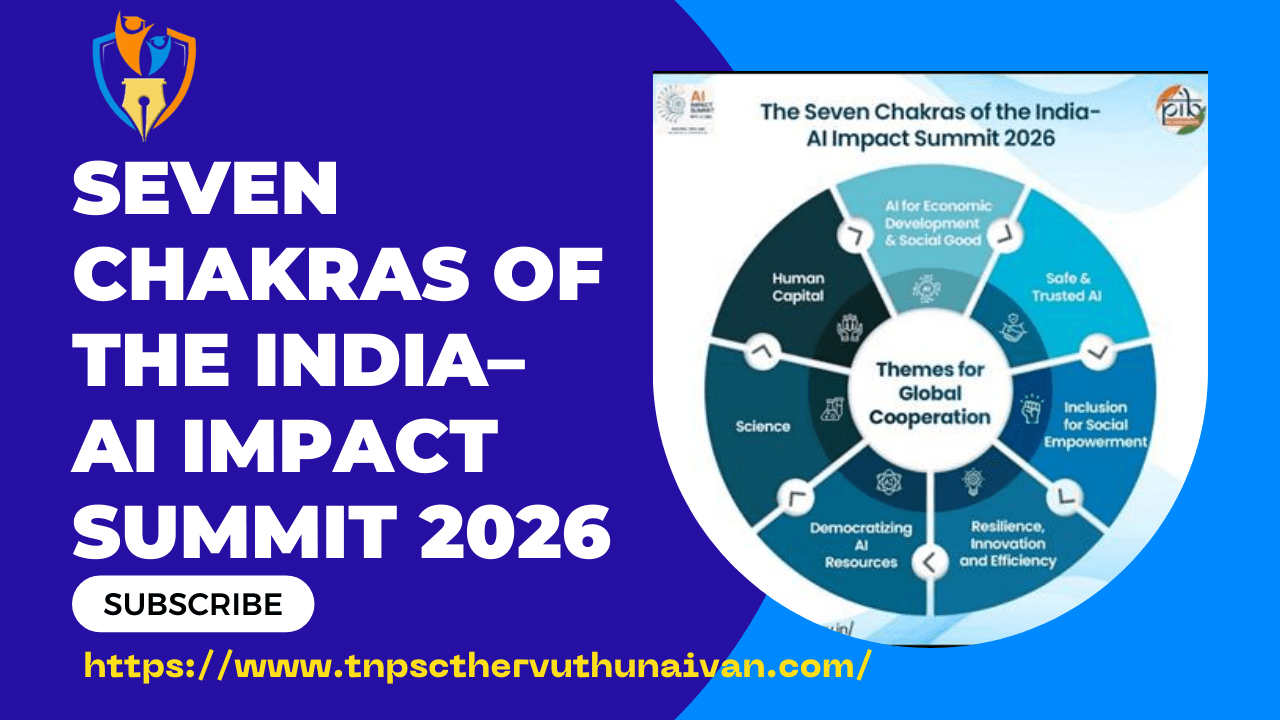
India–AI Impact Summit 2026 highlights India’s vision for responsible, inclusive, and sustainable AI governance based on human-centric principles, innovation, and global cooperation.
India–AI Impact Summit 2026 – Key Highlights
1. Introduction
- The Government of India announced the India–AI Impact Summit 2026 through the Press Information Bureau.
- Summit to be held in New Delhi.
- First major global AI summit hosted in the Global South.
- Aims to shape global norms for responsible, inclusive, and sustainable AI.
2. Vision: The Three Core Principles (Three Sutras)
A. People
- Human-centric AI
- Protection of rights
- Trust and accessibility
- Equitable benefits of technology
B. Planet
- Environmentally sustainable AI
- Energy-efficient systems
- AI supporting climate action
C. Progress
- AI for inclusive economic growth
- Innovation and capacity building
- Bridging development gaps
These principles connect AI governance with social welfare and sustainability.
3. Seven Thematic Areas (Chakras)
| Chakra | Focus Area |
|---|---|
| Human Capital | AI skills, workforce readiness |
| Inclusion for Social Empowerment | AI for accessibility & diversity |
| Safe and Trusted AI | Transparency, accountability, safety |
| Science | AI-enabled research collaboration |
| Resilience & Innovation | Sustainable and efficient AI systems |
| Democratising AI Resources | Access to data, compute & infrastructure |
| AI for Economic Growth & Social Good | Productivity, welfare, development |
These Chakras translate principles into actionable policy domains.
4. India’s Domestic AI Initiatives
Skill Development
- Expansion of AI training and research under the IndiaAI Mission
- Support for students and researchers
Inclusive Digital Access
- Multilingual AI platform BHASHINI
- Voice-based AI services improving governance access
AI Governance
- Establishment of IndiaAI Safety Institute
- Focus on safety, ethics, and regulation
AI Infrastructure
- National compute resources
- Shared data platforms and AI repositories
5. Significance of the Summit
- Positions India as a global convenor in AI governance
- Promotes Global South perspectives in technology policy
- Balances innovation with accountability
- Encourages international cooperation
6. Conclusion
The summit marks a shift from AI discussions to implementation-oriented governance, aiming to ensure AI supports human development, sustainability, and equitable growth rather than widening inequalities.
AI-Driven Economic and Social Impact in India
1. Agriculture
- AI-based advisory systems support sowing decisions, crop planning, and input optimisation
- Use of data analytics improves yield prediction and resource efficiency
- State-level implementations (e.g., Andhra Pradesh, Maharashtra) report significant productivity gains
- Enhances climate resilience and farmer income stability
2. Healthcare
- AI tools enable early disease detection (TB, cancer, neurological disorders)
- Improves diagnostics, imaging analysis, and preventive care
- Reduces burden on healthcare professionals
- Expands access in rural and underserved regions
3. Education
- National Education Policy (NEP) 2020 promotes AI integration in learning
- AI introduced through school curricula and digital learning platforms
- Skill-based initiatives equip students with future-ready digital competencies
- Encourages innovation and research mindset among youth
4. Justice Delivery
- AI and Machine Learning used in court digitisation and case management
- Supports translation of legal content into regional languages
- Improves transparency, efficiency, and citizen access
- Reduces case pendency and procedural delays
5. Economic Growth and Sector Revenue
- AI is a major driver of India’s technology sector expansion
- Boosts productivity, automation, and service innovation
- Contributes to digital economy growth and employment generation
6. Startup Ecosystem
- Rapid rise in AI-enabled startups
- AI integration in products and services across sectors
- Promotes innovation, entrepreneurship, and job creation
- Strengthens India’s global position in emerging technologies
7. Role of the “Seven Chakras” Framework
- Provides a structured governance approach for AI development
- Aligns policy, technology, capacity-building, and regulation
- Encourages responsible innovation and inclusive participation
- Translates guiding principles into measurable socio-economic outcomes
Conclusion
AI in India is not limited to technological advancement but serves as a tool for economic transformation, social inclusion, and governance reform, ensuring technology-driven development with broad societal benefits.




Leave a Reply