
Year End Review 2025 of Department of Drinking Water & Sanitation highlighting Swachh Bharat Mission Grameen Phase II achievements, ODF Plus villages and sanitation reforms.
SOURCE :PIB ENGLISH
Introduction
The Department of Drinking Water & Sanitation under the Ministry of Jal Shakti continues to play a pivotal role in improving rural sanitation and cleanliness in India. The year 2025 marked significant progress under Swachh Bharat Mission – Grameen Phase II, focusing on sustainability, waste management, and community participation.
Major Achievements in 2025
1. Progress towards ODF Plus (Model) Villages
- Over 83% of villages in India have been declared ODF Plus (Model).5.27 lakh villages now have Solid Waste Management (SWM) arrangements.
- 5.41 lakh villages have Liquid Waste Management (LWM) facilities.
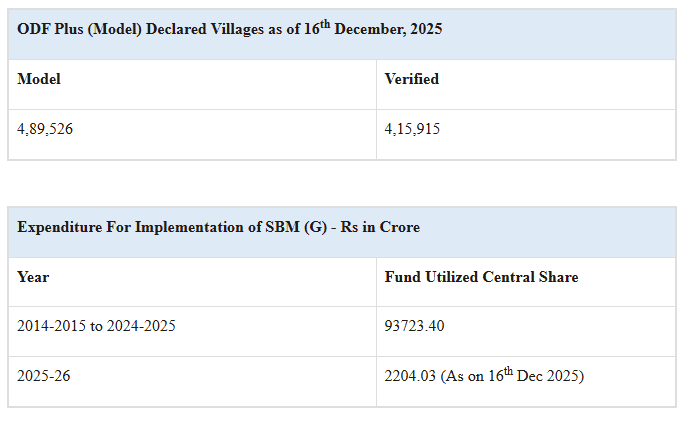
- As on 16 December 2025:4.89 lakh villages declared ODF Plus (Model)4.15 lakh villages verified as ODF Plus (Model)
2. Swachhata Hi Seva (SHS) 2025 Campaign
- Conducted from 17 September to 2 October 2025.
- Witnessed Jan Bhagidari with participation of over 18 crore people, including 13 crore rural citizens.
- Inspired by the Prime Minister’s call “Ek Din, Ek Ghanta, Ek Saath”, mass cleanliness drives were undertaken.
- Hon’ble Union Minister and Ministers of State for Jal Shakti led Shramdaan activities, including a flagship event at Kalindi Kunj, Delhi.
3. Leadership & Community Engagement
- Hon’ble Minister of State for Jal Shakti interacted with over 150 Sarpanches ahead of the 79th Independence Day (2025).
- Focus on strengthening Gram Panchayat-led sanitation governance.
4. Hamara Shauchalay, Hamara Bhavishya Campaign
- Repair and beautification of:
- More than 1 lakh Individual Household Latrines (IHHLs)
- Over 550 Community Sanitary Complexes (CSCs)
- Conducted 49,000+ IEC/BCC activities.
- Participation of over 32 lakh individuals, reinforcing behaviour change and ownership.
About Swachh Bharat Mission – Grameen
- Launched on 2 October 2014 by the Hon’ble Prime Minister Narendra Modi.
- Aimed to eliminate open defecation by 2 October 2019, commemorating the 150th birth anniversary of Mahatma Gandhi.
- Rural sanitation coverage increased from 39% (2014) to 100% (2019).
- All villages across India declared Open Defecation Free (ODF) by 2019.
SBM-G Phase II (Launched in 2020)
Objective
- To achieve Sampoorna Swachhata by:
- Sustaining ODF status
- Ensuring no one is left behind
- Providing comprehensive waste management systems
- Transforming villages into ODF Plus (Model) villages
- Core Components
- ODF Sustainability
- Solid Waste Management
- Liquid Waste Management
- Visual Cleanliness
Key Highlights of SBM-G in 2025
- Total programme outlay: Over ₹1.40 lakh crore
- Since October 2014:
- 12+ crore IHHLs constructed
- 2.67 lakh Community Sanitary Complexes
- Plastic Waste Management arrangements in 5,300+ blocks
- Under GOBARdhan:
- 970+ community biogas plants functional
- Capacity Building:
- 21,306 trainings conducted
- 1,15,274 Gram Panchayats covered
- 32,298 trainers trained (Master & Field Trainers)
Digital Governance: SBM-G Dashboard
- A dynamic, NIC-developed MIS platform.
- Enables real-time monitoring, transparency, and data-driven decision-making.
- Regularly updated by States/UTs to track ODF Plus progress.
Financial PerformanceExpenditure under SBM-G (Central Share – ₹ Crore)
Conclusion
The year 2025 represents a transformational phase for rural sanitation in India. Through strong political leadership, community participation, technological integration, and sustained funding, SBM-G Phase II has moved India closer to Sampoorna Swachhata. The focus on ODF Plus (Model) villages, waste management, and behavioural change ensures that sanitation gains are sustainable, inclusive, and future-ready.




Leave a Reply