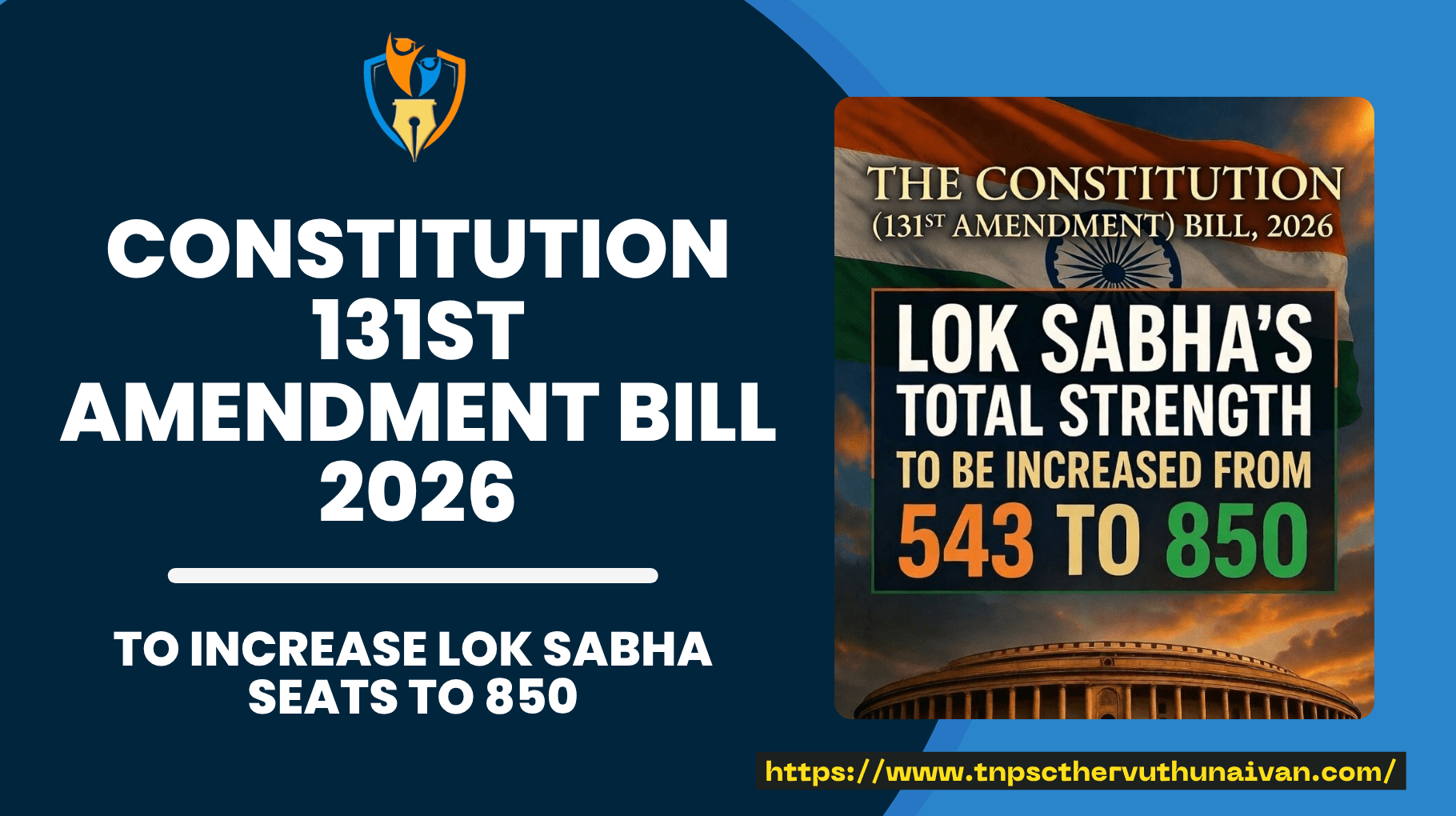
The Union Government proposes the Constitution 131st Amendment Bill 2026 to increase Lok Sabha seats to 850. Learn about delimitation, women’s reservation, and Article 82.
The landscape of Indian democracy is on the verge of a historic transformation. In a bold move to modernize India’s legislative framework, the Union Government has proposed The Constitution (One Hundred and Thirty-First Amendment) Bill, 2026 alongside the Delimitation Bill 2026. These legislative proposals aim to fundamentally alter how citizens are represented in Parliament, addressing decades-old constraints and paving the way for a more inclusive “Viksit Bharat.”
If you are a student preparing for competitive exams, a legal professional, or a curious citizen, understanding these changes is vital. This move isn’t just about changing numbers; it’s about redrawing the map of Indian power and ensuring that every voice in a growing population finds its place in the halls of the Lok Sabha.
What is the Constitution 131st Amendment Bill 2026?
The Constitution 131st Amendment Bill is a landmark proposal that seeks to expand the strength of the Lok Sabha and update the rules governing how constituencies are formed. For over five decades, the number of seats in the Lok Sabha has been largely frozen based on the 1971 Census. As India’s population has grown and shifted, the need for a more representative body has become undeniable.
The bill introduces three major shifts:
- Expansion of Seats: Increasing the total number of Members of Parliament (MPs).
- Early Delimitation: Removing the wait for a new Census to redraw boundaries.
- Women’s Reservation: Fast-tracking the one-third quota for women in legislatures.
Key Highlights of the 131st Constitutional Amendment Bill
This bill proposes specific amendments to the Constitution of India that will have a long-lasting impact on our democratic structure.
1. Increasing the Strength of the Lok Sabha
The most striking feature of the Constitution 131st Amendment Bill is the significant jump in the number of seats.
- Existing Strength: 543 members.
- Proposed Strength: 850 members.
- Distribution: 815 members from the States and 35 members from the Union Territories (UTs).
This expansion ensures that MPs represent a manageable number of constituents, allowing for better governance and more direct accountability to the people.
2. Amending Article 82: The Delimitation Timeline
Article 82 of the Constitution previously mandated that the next delimitation (redrawing of boundaries) could only happen based on the first Census conducted after the year 2026.
The Constitution 131st Amendment Bill proposes to delete this specific proviso. By doing so, the government can carry out delimitation using available Census data before the 2026–27 Census is finalized. This effectively ends the long-standing “seat freeze” and allows for immediate electoral reforms.
3. Amending Article 334A: Implementing Women’s Reservation
One of the most anticipated social reforms in Indian history is the “Nari Shakti Vandan Adhiniyam” or the Women’s Reservation Bill. The 131st Amendment Bill amends Article 334A to allow for the one-third women’s reservation in the Lok Sabha and State Assemblies to take effect immediately after the upcoming delimitation exercise.
Understanding the Delimitation Bill 2026
To implement these changes, the government has introduced the Delimitation Bill 2026. This bill provides the legal machinery required to redraw the map of Indian democracy.
Repealing the Old Act
The new bill will repeal and replace the Delimitation Act of 2002. Since the 2002 Act was based on older constraints, a fresh legal framework is necessary to handle the expansion to 850 seats.
The Delimitation Commission (DC)
Under the Delimitation Bill 2026, the Union Government will constitute a high-powered Delimitation Commission.
- Leadership: The Commission will be chaired by a person who is or has been a Judge of the Supreme Court of India.
- Function: The DC’s primary job is to readjust the allocation of seats in the Lok Sabha and State Assemblies and redraw constituency boundaries based on the latest census figures.
The Power of the Commission’s Orders
Transparency and finality are key to this process. Once the orders issued by the Delimitation Commission are published in the Gazette of India, they:
- Carry the force of law.
- Cannot be questioned in any court of law.
This ensures that the electoral process is not stalled by endless litigation, allowing elections to proceed smoothly under the new boundaries.
Why is the 131st Constitutional Amendment Bill Necessary?
India’s population has more than doubled since the last major seat readjustment. Currently, some MPs represent millions of people, while others represent significantly fewer. This creates an imbalance in “one person, one vote” value.
The Constitution 131st Amendment Bill aims to:
- Improve Representation: More seats mean smaller constituencies and better access to representatives.
- Social Justice: By linking delimitation to women’s reservation, it ensures that women are given their rightful 33% share in law-making sooner rather than later.
- Modernize Governance: The new Parliament building (Sansad Bhavan) was designed specifically to accommodate this increased number of members.
Impact on State Assemblies
While the focus is often on the Lok Sabha, the Delimitation Bill 2026 and the 131st Amendment also heavily impact State Legislative Assemblies. The Delimitation Commission will redraw state boundaries to ensure that regional representation is also balanced and fair, following the same principles of population-based seat allocation.
Conclusion: A New Era for Indian Democracy
The proposal of The Constitution (One Hundred and Thirty-First Amendment) Bill, 2026 and the Delimitation Bill 2026 marks a turning point in India’s political journey. By expanding the Lok Sabha to 850 members and fast-tracking women’s reservation, the government is signaling a commitment to a more robust and inclusive democratic process.
As these bills move through the legislative process, they will undoubtedly spark discussions on federalism, regional representation, and the future of governance. However, the core objective remains clear: to ensure that the “Temple of Democracy” reflects the true pulse of 1.4 billion Indians.
FAQ: Long-Tail Keywords for Voice Search
1. What is the proposed strength of Lok Sabha in the 131st Constitutional Amendment Bill? The bill proposes to increase the strength of the Lok Sabha from 543 to 850 members, including 815 from states and 35 from Union Territories.
2. When will the women’s reservation be implemented in India? According to the Constitution 131st Amendment Bill, one-third women’s reservation will be implemented in the Lok Sabha and State Assemblies immediately after the delimitation exercise is completed.
3. Who will head the Delimitation Commission 2026? The Delimitation Commission will be chaired by a retired or serving Judge of the Supreme Court of India, as appointed by the Union Government.
4. Can the orders of the Delimitation Commission be challenged in court? No. Once the orders of the Delimitation Commission are published in the Gazette of India, they have the force of law and cannot be called into question in any court.
5. Why is the government amending Article 82 of the Constitution? The amendment to Article 82 is intended to remove the restriction that prevents delimitation until after the first census post-2026, allowing the process to start earlier using existing data.