Complete analysis of the 850-seat Lok Sabha expansion, Delimitation Bill 2026, and its impact on Tamil Nadu. Perfect for UPSC and TNPSC aspirants.
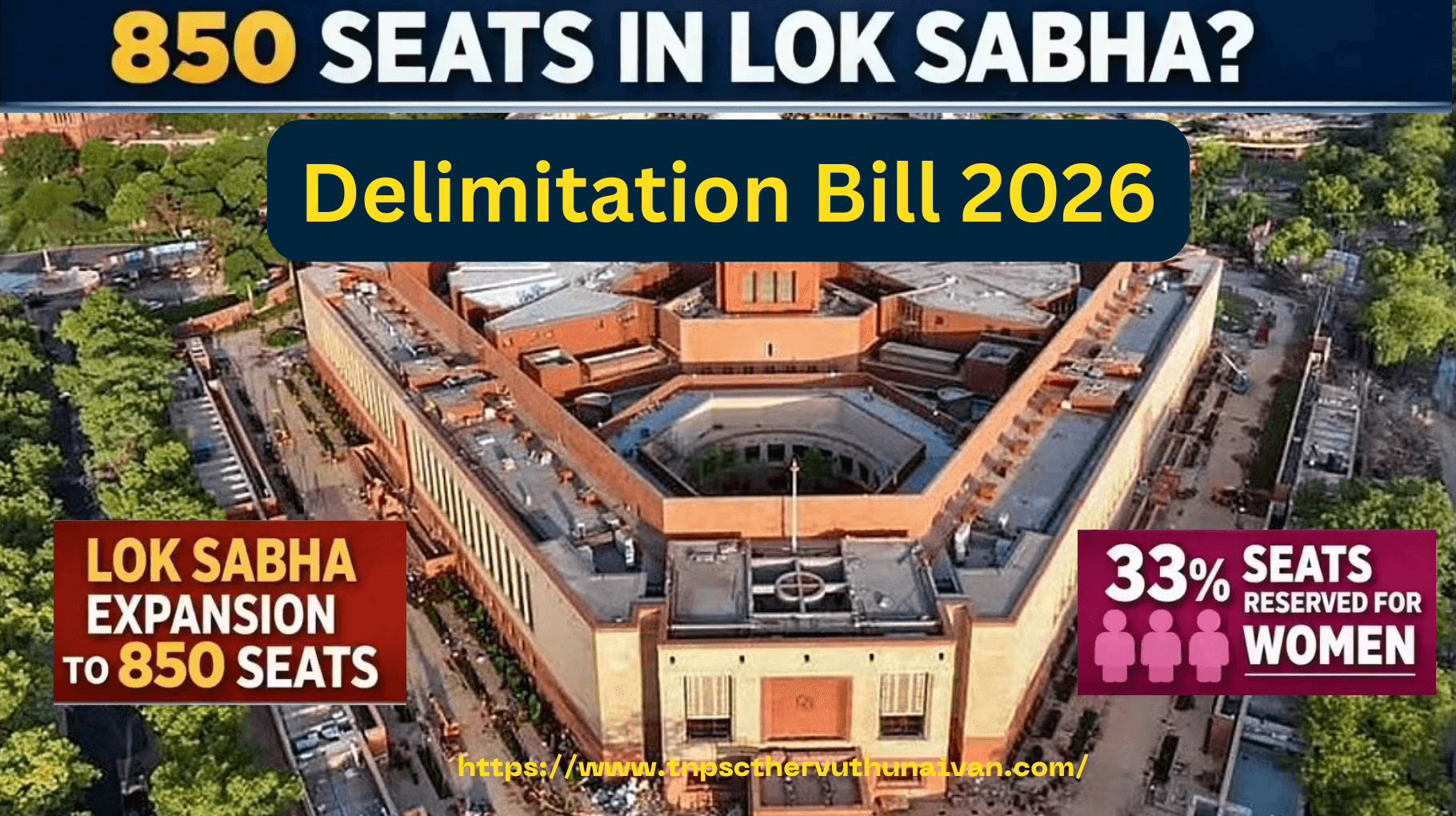
The Union Government has introduced the Delimitation Bill 2026 alongside the Constitution (131st Amendment) Bill. This move seeks to increase the Lok Sabha strength to 850 seats, finally decoupling the 33% Women’s Reservation from the traditional census delay, potentially reshaping India’s electoral landscape and federal dynamics.
Prelims Table : Delimitation Bill 2026
| Feature | Details |
| Relevant Articles | Article 81 (LS Composition), Article 82 (Delimitation), Article 170 (Assemblies) |
| Current Freeze | Seats frozen at 1971 levels until 2026 (84th Amendment) |
| New Proposed LS Total | 850 Seats (815 for States, 35 for UTs) |
| Mandatory Quota | 33% seats reserved for women in LS and State Assemblies |
| Authority | Delimitation Commission (headed by a retired SC Judge) |
What is Delimitation?
Delimitation is the process of redrawing boundaries of territorial constituencies for the Lok Sabha and State Assemblies to ensure that each seat represents an equal population, adhering to the principle of “One Vote, One Value.”
Why in News?
The government plans to enact the Nari Shakti Vandan Adhiniyam (Women’s Reservation) by performing a delimitation exercise in 2026. This ends the decades-long freeze on seat numbers, aiming to align representation with current population data.
Key Facts for Prelims
- Historical Commissions: Established in 1952, 1963, 1973, and 2002.
- Constitutional Amendments: The 42nd Amendment (1976) froze seats; the 84th Amendment (2001) extended this until 2026.
- Commission Composition: Includes a Retired SC Judge, Chief Election Commissioner, and State Election Commissioners.
- Finality of Orders: Under Article 82, orders of the Commission have the force of law and cannot be challenged in any court.
Detailed Mains Analysis
Significance
- Democratic Justice: Corrects the under-representation of states with high population growth.
- Gender Parity: Directly facilitates the entry of 1/3rd women into the highest legislative bodies.
- Better Governance: Smaller constituencies allow for more direct contact between MPs/MLAs and their voters.
Challenges / Issues
- Federal Imbalance: Southern states like Tamil Nadu and Kerala, which successfully controlled population, may lose relative political power to Northern states (UP, Bihar).
- The “Performance Penalty”: States that achieved demographic transition feel “punished” with fewer seats.
- Delinking Concerns: Critics argue the wait for delimitation delayed women’s reservation unnecessarily.
Way Forward / Solutions
- Seat Weightage: Exploring models where seat increases don’t reduce the existing political “weight” of performing states.
- Strengthening Rajya Sabha: Enhancing the role of the Upper House to protect the interests of states regardless of population.
- Inter-State Council: Using constitutional bodies to build consensus between North and South.
Tamil Nadu Perspective
- Current Status: Tamil Nadu has 39 Lok Sabha seats based on the 1971 Census.
- The TN Concern: If the 2026 delimitation is purely population-based, TN’s share could shrink relative to Northern states, affecting its influence on Central Funds and policy.
- State Stance: The TN Assembly has passed resolutions advocating for the protection of current seat ratios to honor the state’s family planning achievements.