
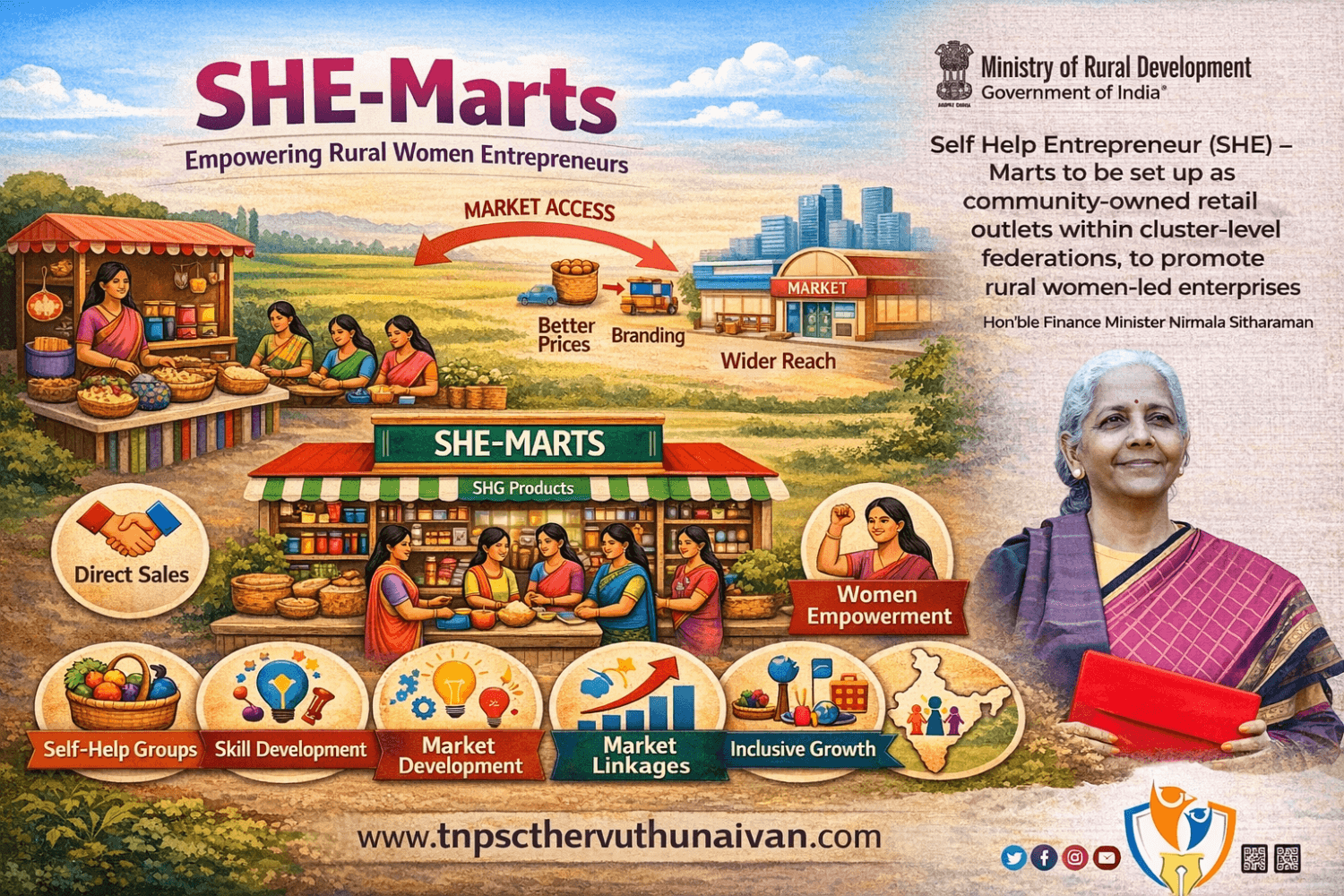
SHE-Marts is a revolutionary platform designed to empower rural women entrepreneurs by providing market access, financial opportunities, and business growth support. Learn how it is transforming rural economies.
Context : SHE-Marts
In February 2026, the Government introduced ‘SHE-Marts’ to improve market access for rural women entrepreneurs, marking a strategic shift from mere financial inclusion to enterprise-driven empowerment within the Self-Help Group (SHG) ecosystem. This initiative reflects the growing emphasis on women-led development and rural entrepreneurship under the Deendayal Antyodaya Yojana – National Rural Livelihoods Mission (DAY-NRLM), aiming to bridge the long-standing gap between access to credit and the generation of sustainable livelihoods for SHG members.
SHE-Marts: Transitioning from Micro-Credit to Macro-Enterprise
In a significant move towards rural economic transformation, the Ministry of Rural Development has announced the setting up of Self Help Entrepreneur (SHE) Marts. Positioned under the Deendayal Antyodaya Yojana-National Rural Livelihoods Mission (DAY-NRLM), this initiative is designed to bridge the gap between rural production and urban/local consumption.
What are SHE-Marts?
SHE-Marts are structured retail platforms envisaged as a new market ecosystem for rural women entrepreneurs within the Self Help Group (SHG) network. Unlike traditional local haats, these marts are designed to be community-owned retail outlets established within cluster-level federations.
Key Objectives
The initiative focuses on four primary pillars:
- Market Access: Providing a dedicated space for SHG products to be sold directly to consumers.
- Visibility: Enhancing the branding and market presence of local, indigenous products.
- Institutional Strengthening: Using these retail hubs to bolster the organizational capacity of SHG institutions.
- Scaling Enterprises: Enabling women to move beyond subsistence and scale their businesses into sustainable commercial ventures.
Strategic Shift: Inclusion to Empowerment
Historically, rural development focused on financial inclusion—ensuring women had access to credit. SHE-Marts represent a strategic pivot toward enterprise-led empowerment. By providing market access and capacity-building, the government aims to support women in transitioning from mere participants in credit-linked activities to becoming owners of sustainable enterprises.
Implementation and Financing
The marts will be established through innovative financing instruments. It is important to note for exam purposes that as of the recent announcement by the Minister of State for Rural Development, Dr. Chandra Sekhar Pemmasani, the initiative is in its early stages, and no funds have been sanctioned or spent as of yet.
Significance of SHE-Marts
The significance of SHE-Marts lies in their role as catalysts for economic structural change within the rural ecosystem:
- Direct Market Access: These marts act as structured retail platforms, allowing SHG members to sell products directly to consumers, thereby bypassing intermediaries and securing better profit margins.
- Enhanced Visibility: By providing a dedicated space to showcase local products, the initiative improves the brand visibility of indigenous rural goods.
- Institutional Strengthening: The marts are designed to be community-owned outlets situated within cluster-level federations, which strengthens the organizational capacity and self-reliance of SHG institutions.
- Strategic Economic Pivot: The initiative facilitates a move from credit-linked livelihood activities to making women the actual owners of sustainable enterprises, fostering long-term economic independence.
- Scaling and Expansion: It provides the necessary infrastructure and capacity-building required for women entrepreneurs to scale their micro-businesses into competitive commercial entities.
Challenges in Implementation
While the vision is transformative, the sources highlight specific areas that may pose challenges during the rollout:
- Funding and Sanctioning: As of March 2026, the Minister of State for Rural Development confirmed that no funds have been sanctioned or spent so far, indicating that the initiative is in its nascent stage and may face initial delays in physical establishment.
- Requirement for Innovative Financing: The government intends to set up these marts through enhanced and innovative financing instruments, which necessitates the development of new financial frameworks that rural institutions must learn to navigate.
- Transition Complexity: Moving from basic credit-linked activities to full-scale enterprise ownership requires significant and sustained capacity-building to ensure women can manage the complexities of retail and supply chain management.
- Sustainable Management: Establishing these as community-owned outlets requires high levels of coordination and management skills at the cluster level to ensure the marts remain viable and profitable over time.
Conclusion
SHE-Marts are poised to become a cornerstone of the rural economy by addressing the “last-mile” marketing hurdle. By empowering women to own the retail chain, the initiative ensures that the value created at the rural level stays within the community, fostering a more resilient and self-reliant (Atmanirbhar) rural India.




Leave a Reply