e-NAM (National Agriculture Market) | 10 Years of Digital Transformation of Agricultural Trade in India
SOURCE : PIB ENGLISH | TAMIL
National Agriculture Market (e-NAM): Revolutionizing India’s Agricultural Trade
Key Highlights of e-NAM
- Unified Digital Market: A pan-India electronic trading platform that integrates existing mandis to create a “One Nation, One Market” ecosystem.
- Massive Trade Value: Since its inception, the platform has facilitated a total trade value of ₹4.84 lakh crore as of March 2026.
- Wider Outreach: Successfully registered over 1.80 crore farmers and more than 4,700 Farmer-Producer Organizations (FPOs).
- Tech-Driven Transparency: Features AI-enabled quality assessment, a live price dashboard, and a 12-language interface for accessibility.
Introduction
For years, the Indian agricultural sector faced fragmentation, with farmers often limited to selling their produce within local Agricultural Produce Market Committee (APMC) mandis. This physical boundary often resulted in limited price discovery and reduced profits for the primary producers. However, the launch of the National Agriculture Market (e-NAM) in April 2016 marked a paradigm shift.
By digitally integrating these mandis, e-NAM has transformed the way agricultural commodities are traded in India. It has moved the market from physical silos to a unified national digital space, ensuring that a farmer in one state can reach a trader in another with ease and transparency.
What is the e-NAM Platform?
The National Agriculture Market (e-NAM) is an innovative electronic trading portal which networks the existing APMC mandis to create a unified national market for agricultural commodities.
Implementation and Governance
The scheme is implemented by the Small Farmers Agribusiness Consortium (SFAC), which acts as the lead agency. It operates under the aegis of the Ministry of Agriculture and Farmers’ Welfare, ensuring that the policy-level vision of “One Nation, One Market” is executed effectively at the ground level.
Key Features of e-NAM
1. Advanced Multi-Layered Architecture
e-NAM is not just a website; it is a sophisticated digital ecosystem. It encompasses:
- Web Portal and Mobile App: Easy access for farmers and traders to participate in auctions.
- AI-Enabled Systems: Advanced quality assessment systems that use Artificial Intelligence to provide accurate grading of produce.
- Platform of Platforms (PoP): A comprehensive framework that integrates various service providers to offer a single-window service for logistics, quality testing, and payments.
2. Integration with e-NWR (Electronic Negotiable Warehouse Receipt)
One of the most revolutionary aspects of e-NAM is its integration with the e-NWR system. Under the Warehousing (Development and Regulation) Act, 2007, e-NWR is a secure electronic instrument certifying the ownership of stored commodities.
- Storage and Sale: Farmers and FPOs can store produce in warehouses accredited by the WDRA (Warehousing Development and Regulatory Authority).
- Direct Selling: They can obtain e-NWRs and sell their stored commodities directly on the e-NAM platform, avoiding distress sales during harvest peaks.
3. Inter-State Trade and Accessibility
e-NAM has successfully broken geographical barriers by providing:
- Inter-state trade facilities that allow for a wider reach beyond local markets.
- A 12-language interface to ensure that language is never a barrier for farmers across India’s diverse regions.
- Live Price Dashboards to provide real-time data for better decision-making.
Major Achievements and Growth (2016–2026)
The impact of e-NAM over the last decade has been substantial, showing steady growth in network size and trade volume.
Network Expansion
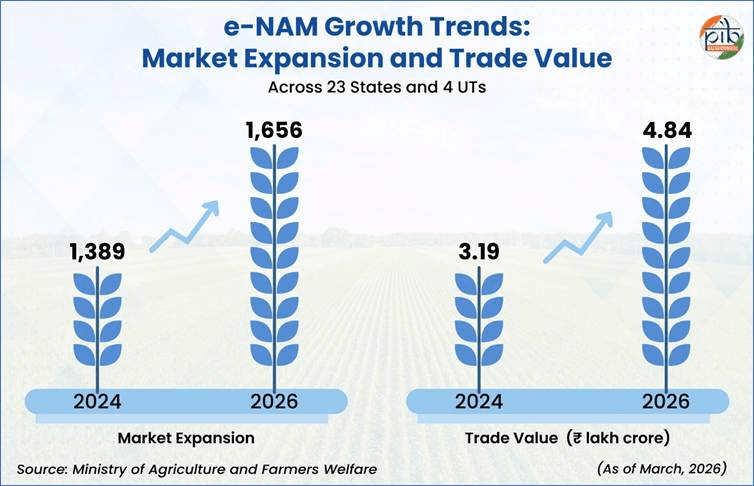
The digital footprint of the platform has grown significantly. The number of connected mandis rose from 1,389 in 2024 to 1,656 by March 2026, bringing more rural markets into the digital fold.
Trading Volume and Value
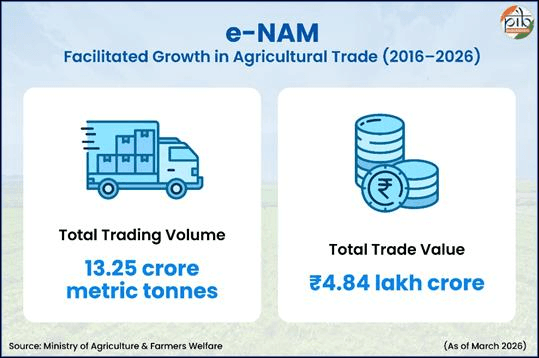
- Volume: From 2016 to March 2026, the platform facilitated the trading of 13.25 crore metric tonnes of commodities.
- Value: This massive volume translated into a total trade value of ₹4.84 lakh crore, proving the platform’s commercial viability.
The Growing Community
The platform has become a trusted marketplace for millions:
- 1.80 crore+ Registered Farmers.
- 2.73 lakh Registered Traders.
- 4,724 Farmer-Producer Organizations (FPOs).
FAQs: Understanding the e-NAM Ecosystem
1. How does e-NAM benefit a small farmer? e-NAM provides small farmers with access to a larger pool of buyers across India. This increased competition among traders leads to better price discovery and ensures farmers get a fair price for their hard work.
2. What is the role of SFAC in e-NAM? The Small Farmers Agribusiness Consortium (SFAC) is the lead agency responsible for the technical and operational implementation of the e-NAM platform under the Ministry of Agriculture.
3. What is an e-NWR and why is it important for e-NAM? An Electronic Negotiable Warehouse Receipt (e-NWR) is a digital document that proves ownership of goods stored in an accredited warehouse. It allows farmers to wait for better market prices while using the receipt to sell directly on the e-NAM portal.
4. How many languages does the e-NAM interface support? To ensure inclusivity, the platform currently supports a 12-language interface, making it accessible to farmers and traders from different linguistic backgrounds.
5. What is the “Platform of Platforms” (PoP) concept? The PoP initiative integrates various independent service providers (like logistics, fintech, and quality assaying) into the e-NAM portal, creating a “one-stop shop” for all agricultural trading needs.
Conclusion
The National Agriculture Market (e-NAM) has successfully transitioned Indian agriculture from traditional, localized trading to a modern, digital-first ecosystem. By overcoming the limitations of physical APMC mandis and integrating advanced technologies like AI and e-NWR, the scheme has empowered millions of farmers. As the network continues to expand toward 2000 mandis and beyond, it remains the backbone of India’s vision for a unified, transparent, and profitable agricultural market.