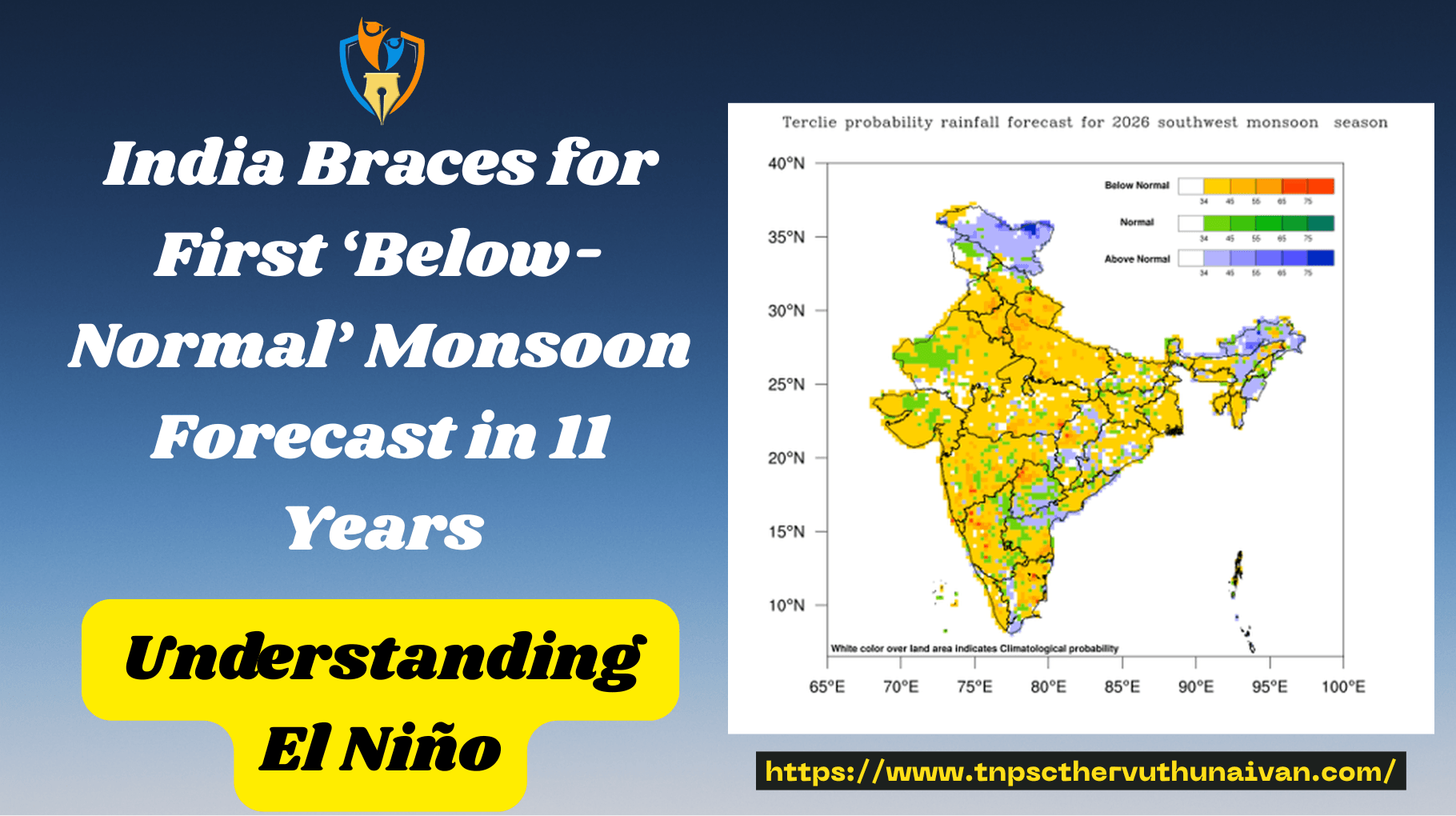
India Braces for First ‘Below-Normal’ Monsoon Forecast in 11 Years | Understanding El Niño
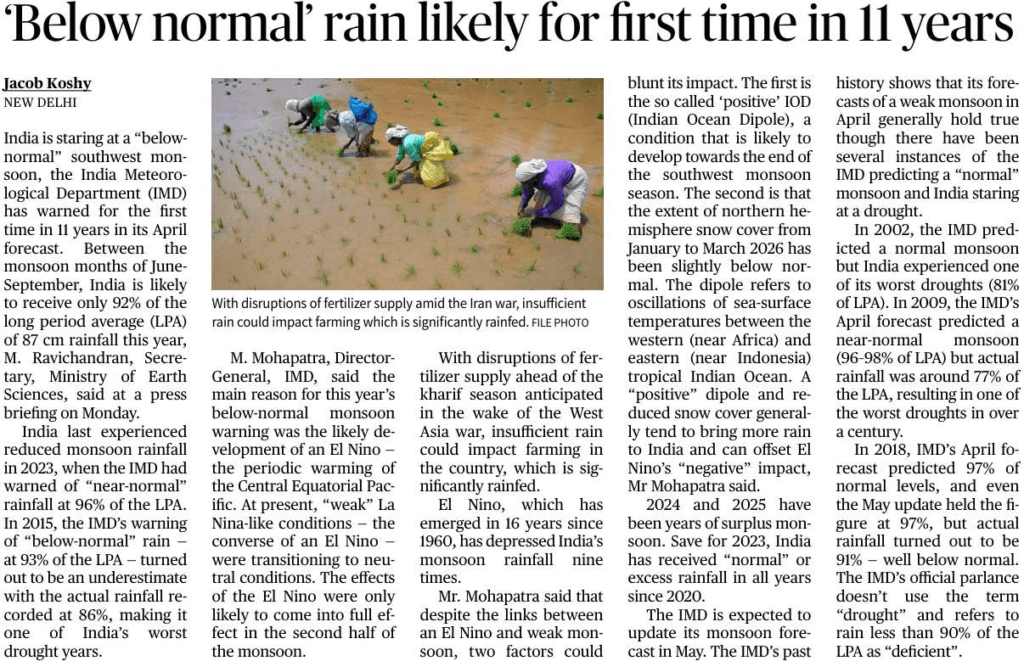
New Delhi — For the first time in over a decade, the India Meteorological Department (IMD) has issued a “below-normal” southwest monsoon forecast in its initial April briefing. This warning signals potential challenges for India’s agricultural sector, which remains heavily dependent on seasonal rains.
The Forecast by the Numbers
According to M. Ravichandran, Secretary of the Ministry of Earth Sciences, India is expected to receive only 92% of the Long Period Average (LPA). The LPA for the monsoon season (June to September) is established at 87 cm.
While the IMD last warned of reduced rainfall in 2023 (predicting 96%), the last time a “below-normal” tag was issued this early was in 2015. That year, the actual rainfall plummeted to 86%, resulting in a severe drought.
The El Niño Factor
The primary driver behind this somber outlook is the development of El Niño—the periodic warming of the Central Equatorial Pacific waters.
- Current Status: The Pacific is currently transitioning from “weak” La Niña-like conditions to neutral.
- Impact: El Niño is expected to take full effect during the second half of the monsoon season.
- Historical Context: Since 1960, El Niño has emerged 16 times, leading to depressed monsoon rainfall in India on nine of those occasions.
Potential Saving Graces
Despite the El Niño threat, M. Mohapatra, Director-General of the IMD, identified two factors that could blunt the impact:
- Positive Indian Ocean Dipole (IOD): A condition involving temperature oscillations between the western and eastern tropical Indian Ocean. A “positive” dipole typically brings more rain to India.
- Reduced Northern Hemisphere Snow Cover: Below-normal snow cover from January to March 2026 may also help offset some of El Niño’s negative effects.
Risks to Agriculture
The timing of this forecast is particularly concerning for the Kharif season. Indian farming is significantly rainfed, and the threat of insufficient rain is compounded by disruptions in fertilizer supplies due to ongoing conflict in West Asia (the Iran war).
A History of Forecasting Challenges
The article notes that April forecasts are not always definitive. The IMD has a mixed record of accuracy:
- 2002: Predicted “normal” rain; India suffered its worst drought (81% of LPA).
- 2009: Predicted “near-normal” rain; actual rainfall was 77%, a century-level low.
- 2018: Predicted 97% of LPA; actual rainfall was 91%.
In official IMD terminology, “deficient” rain is defined as less than 90% of the LPA, though the term “drought” is generally avoided in formal parlance. The IMD is expected to provide an updated, more detailed forecast in May.
Understanding El Niño
El Niño represents the “warm phase” of the El Niño-Southern Oscillation (ENSO), characterized by the unusual warming of surface waters in the eastern tropical Pacific Ocean.
- Atmospheric Changes: During this phase, the trade winds—the east-west winds near the Equator—weaken and may even change direction to become westerlies.
- Water Movement: These westerlies push warm water from the western Pacific toward the Americas.
- Impact on Marine Life: The process of upwelling (the rise of nutrient-rich cold water) is reduced. This leads to a decline in phytoplankton, which disrupts the entire marine food chain and affects coastal fisheries.
Global Impacts of El Niño
The consequences of El Niño reach far beyond the Pacific Ocean, affecting weather, health, and ecosystems across multiple continents.
1. Drastic Shifts in Rainfall
- South America: Experiences a massive increase in precipitation, which often leads to coastal flooding and severe erosion.
- Indonesia and Australia: Conversely, these regions face intense droughts. These droughts threaten water supplies, dry up reservoirs, and jeopardize agriculture dependent on irrigation.
2. Health and Ecological Risks
- Disease Outbreaks: Flooding is linked to spikes in cholera, dengue, and malaria.
- Respiratory Issues: Drought conditions can trigger wildfires, leading to widespread respiratory problems.
- Ecosystem Disruption: Warm waters carry tropical species into colder areas, upsetting the balance of local ecosystems.
3. Potential Positive Impacts
While largely destructive, El Niño can have specific localized benefits:
- Hurricane Suppression: It is known to reduce the frequency of hurricanes in the Atlantic Ocean.
Summary Table: Regional Consequences
| Region | Primary Impact | Secondary Consequences |
| South America | Increased Rainfall | Coastal flooding, erosion, and water-borne diseases |
| Australia & Indonesia | Severe Drought | Water supply depletion, agricultural failure, and wildfires |
| Atlantic Ocean | Reduced Hurricanes | Fewer instances of tropical storm damage |
| Eastern Pacific | Weakened Trade Winds | Reduced upwelling and collapse of fish populations |